HalalHub.vn · In-depth analysis · 8 November 2026
(HalalHub.vn) – Vietnam is a major exporter of pepper, cinnamon and star anise, but much is still sold as raw ingredients. Over four weeks from SIAL Paris to Vietnam Foodexpo, one Vietnamese spice business is taking shrimp salt, pho seasoning and chili-lime salt to new markets. For Muslim consumers, these high-value processed products also carry the most complex Halal requirements. This article examines opportunities, risks and a preparation roadmap.
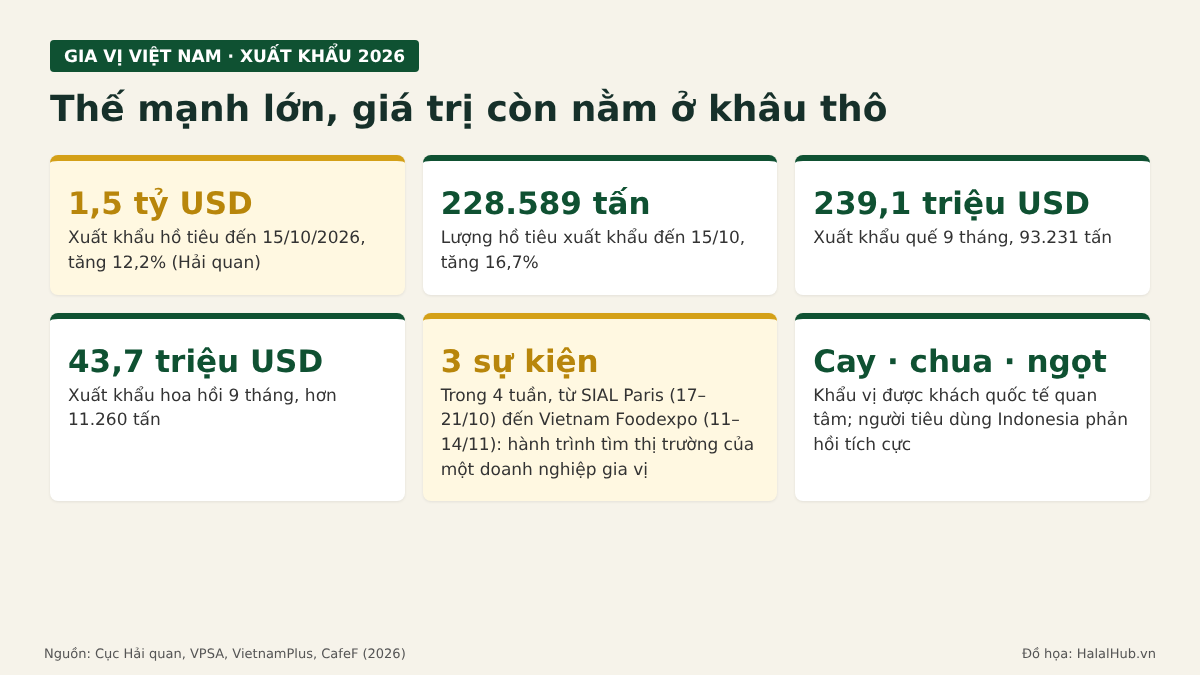
Vietnam’s spice exports in 2026. Graphic: HalalHub.vn, compiled from Customs, VPSA, VietnamPlus and CafeF.
1. Billion-dollar strengths, mostly in raw ingredients
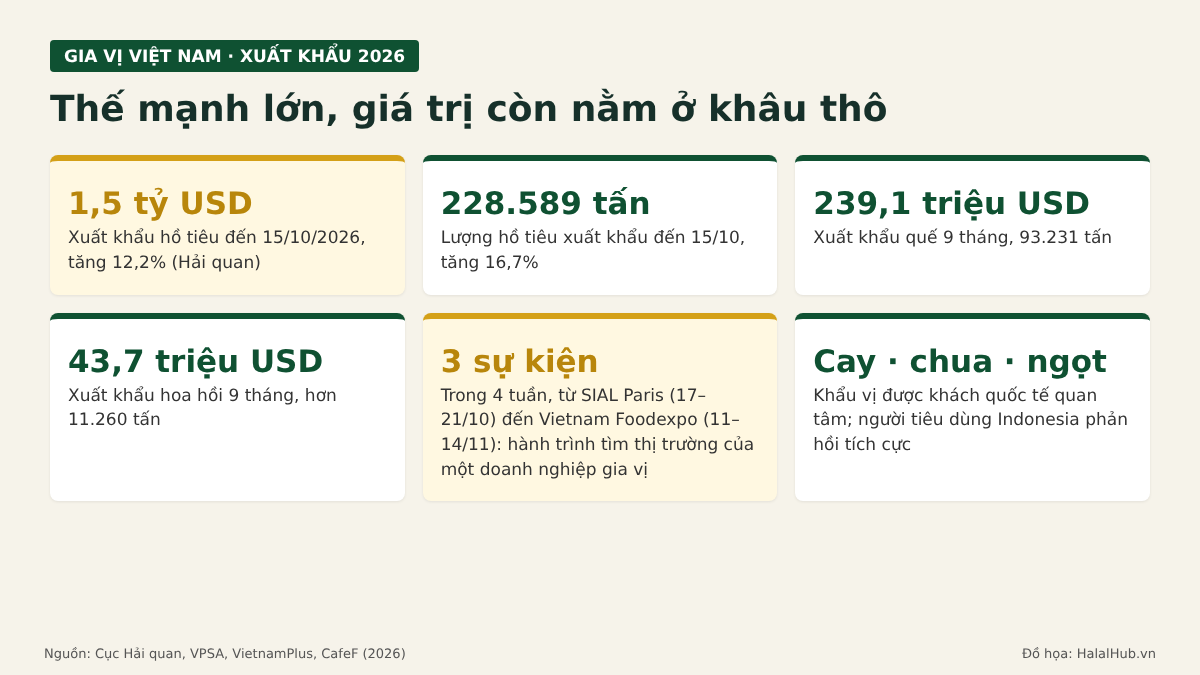
Customs figures show Vietnam exported 228,589 tonnes of pepper worth US$1.5 billion through 15 October 2026, up 16.7% in volume and 12.2% in value year on year. In the first nine months, cinnamon exports reached US$239.1 million and star anise US$43.7 million. Industry reporting highlights growing price competition and the decisive importance of quality.
Most output is still exported as whole seeds, sticks or single-ingredient powders. Greater added value lies in seasoning blends, cooking kits and sauces that bring Vietnamese flavors into overseas kitchens.
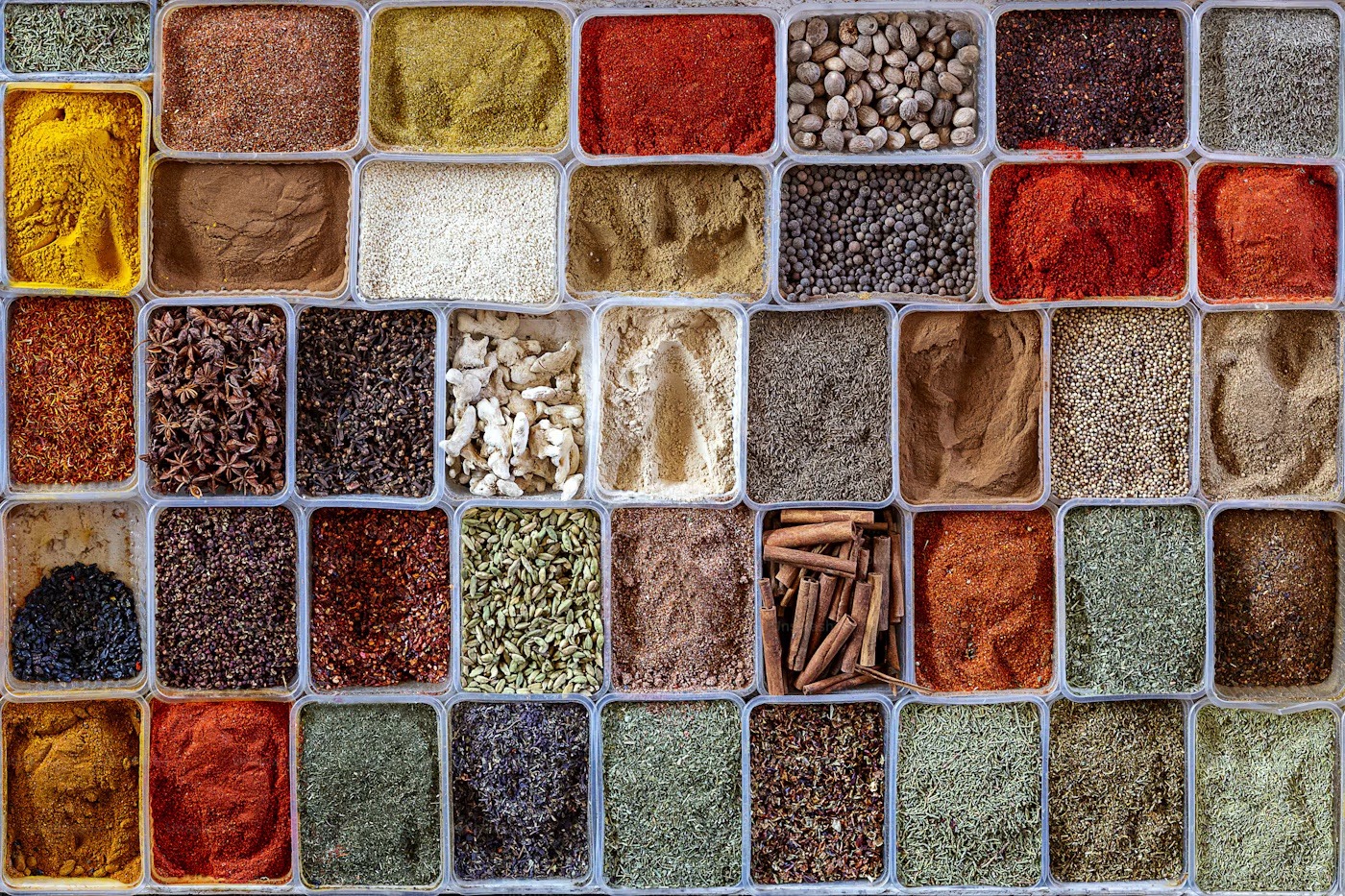
Pepper, cinnamon and star anise are Vietnamese export strengths. Illustrative photo: Unsplash.
2. Four weeks, three events: Lessons from a spice business
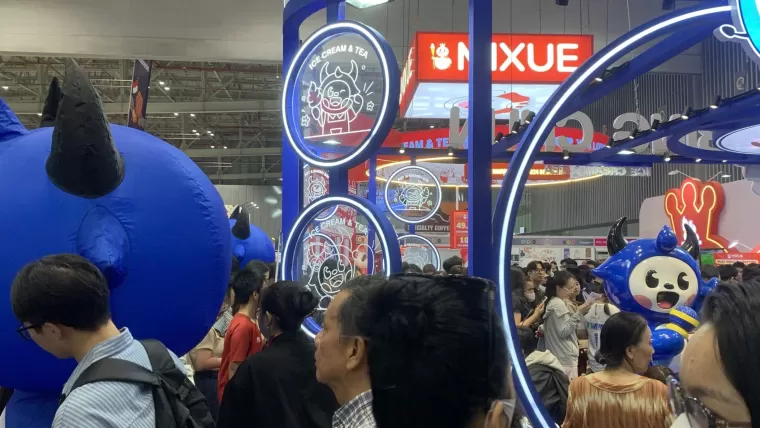
According to CafeF, Dh Foods is participating in three successive events over about four weeks: SIAL Paris on 17–21 October, another exhibition and Vietnam Foodexpo on 11–14 November. Alongside popular products, it is presenting specialties such as Tay Ninh shrimp salt, Hanoi beef pho seasoning and Nha Trang chili-lime salt to explore demand.
Early feedback indicates particular interest in spicy products and balanced sweet, sour and hot flavors, with Indonesian consumers responding positively to Vietnamese seasonings. The report emphasizes exhibitions as a way to identify markets, not an end in themselves. The real challenge is adapting Vietnamese flavors to each country’s tastes, standards and distribution system.
| 💡 WHY THIS SIGNAL MATTERS Indonesia is the world’s largest Muslim consumer market, with preferences for spicy, strong flavors close to Vietnamese tastes. But processed seasonings will need BPJPH-accepted Halal certification under the timeline to 2028 to reach Indonesian supermarket shelves. Positive flavor feedback is only the beginning. |
3. Halal risks by product group
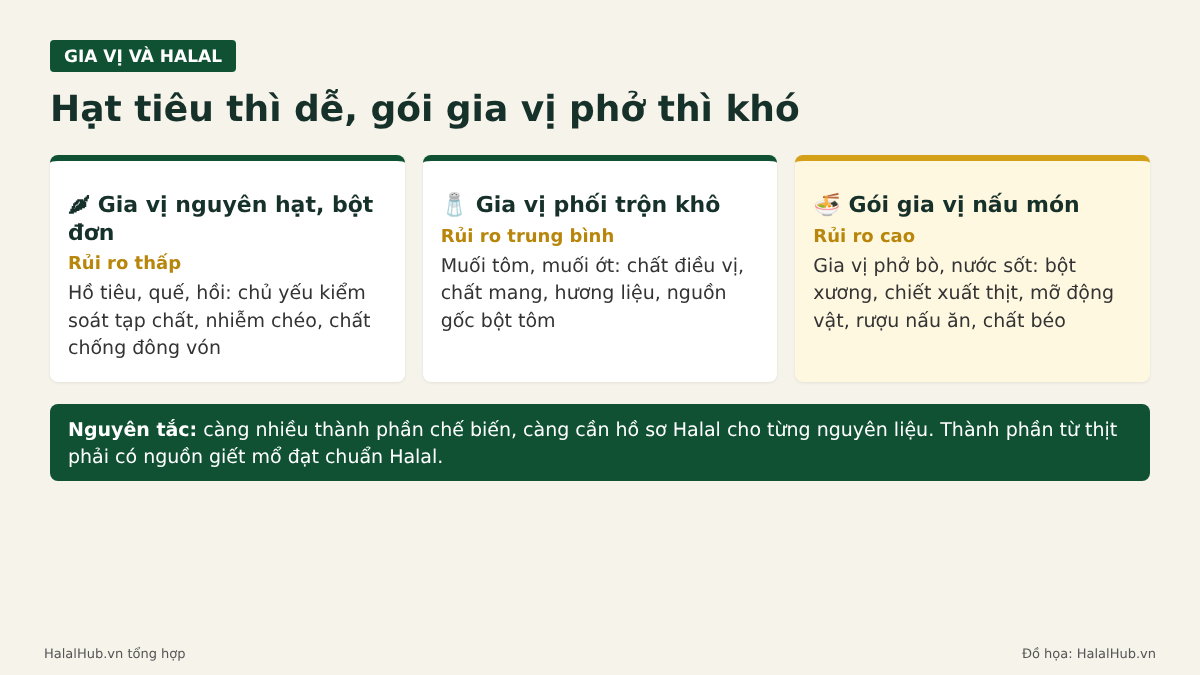
Halal risk levels across three seasoning categories. Graphic: HalalHub.vn.
| Product group | Control points | Examples |
| Whole spices and single-ingredient powders | Impurities, production-line cross-contamination and anticaking agents | Black pepper, cinnamon sticks, star anise, cinnamon powder |
| Dry blends | Flavor enhancers, carriers such as maltodextrin, flavorings, and origins of shrimp or fish powder | Shrimp salt, chili-lime salt, marinades |
| Cooking kits and sauces | Bone powder, meat extracts, animal fats, cooking alcohol and enzymes; meat must come from Halal slaughter sources | Beef pho seasoning, hotpot seasoning, braising sauces |
Source: compiled by HalalHub.vn. Specific requirements depend on the certification body’s standard and the destination market.
Beef pho seasoning is a notable case: its signature flavor comes from beef-bone broth. If a sachet contains bone powder or beef extract, those ingredients need a Halal-compliant slaughter source and supporting documentation. Many businesses use natural plant-based flavor formulations or Halal-certified meat ingredients to address this.
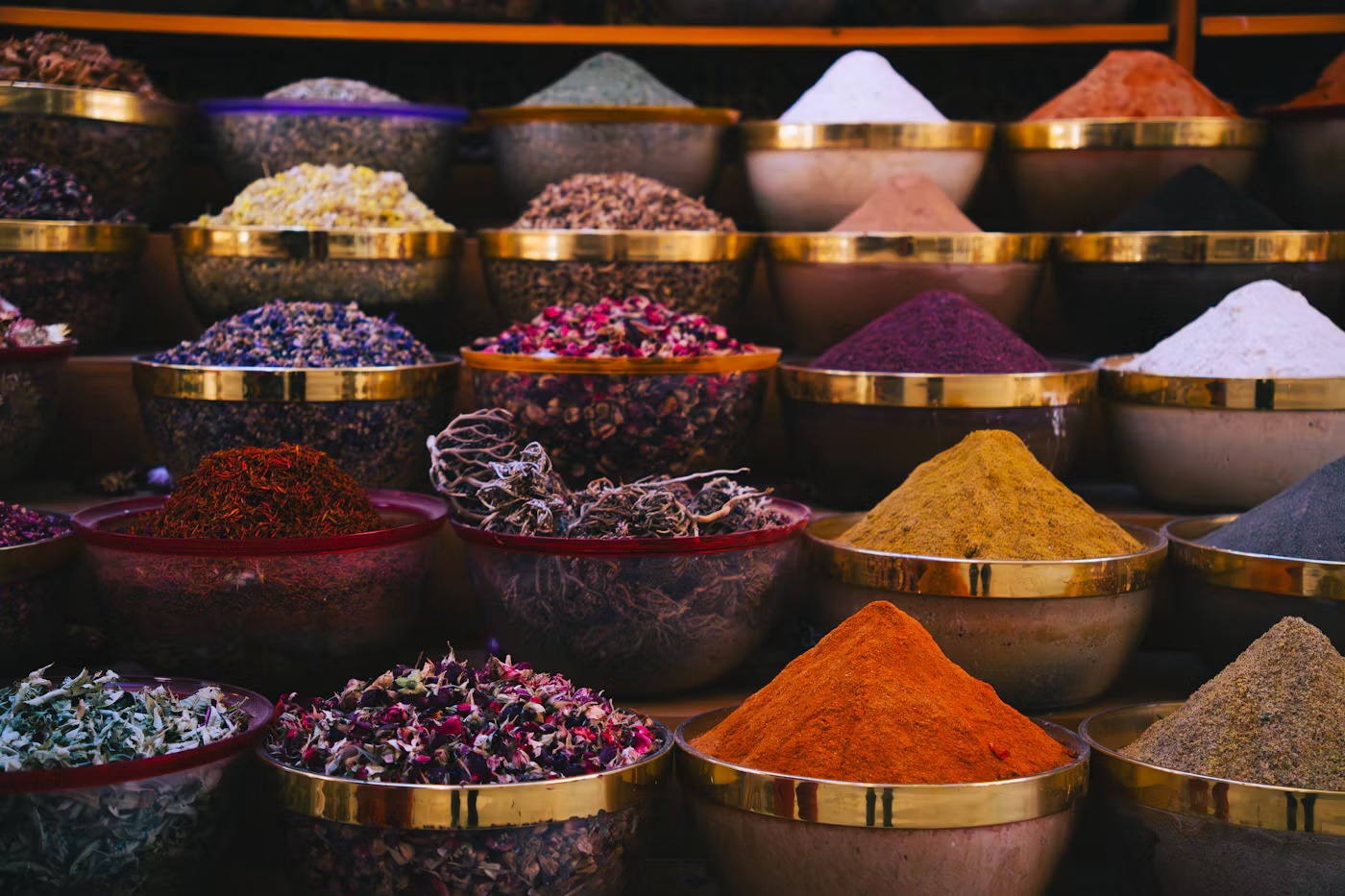
Powdered and blended seasonings contain multiple ingredients, requiring close Halal control from inputs to production lines. Illustrative photo: Unsplash.
4. A roadmap for spice businesses
Divide the portfolio into three risk levels; start certification with whole spices and single-ingredient powders for a faster route to market readiness.
Review blends and cooking kits, listing ingredients that require Halal documentation from suppliers.
Replace risky components where possible: plant-based flavorings, certified flavor enhancers and recipes without cooking alcohol.
Segregate lines or establish production scheduling and cleaning if the factory also makes non-Halal products.
Choose certification bodies by destination: BPJPH agreements for Indonesia, JAKIM recognition for Malaysia, and relevant MoIAT or SFDA acceptance for Middle Eastern markets.
Use exhibitions to validate flavor preferences and buyer certification requirements before major investment.
| 🇻🇳 THE NEAREST OPPORTUNITY Vietnam Foodexpo 2026, 11–14 November at SECC, features more than 100 Halal businesses. Spice businesses can meet buyers from Muslim markets, learn their certification requirements and find suppliers of certified ingredients. |
5. Conclusion
Pepper has taken Vietnamese spices worldwide; pho seasoning could take Vietnamese brands into Muslim consumers’ kitchens. The gap involves processing capability and proof that every ingredient meets Halal requirements. Early preparation can turn positive flavor feedback into real orders.
Glossary
VPSA: Vietnam Pepper and Spice Association.
SIAL Paris: a major international food exhibition held in France.
Carrier: an ingredient helping disperse flavorings or flavor enhancers in powdered seasonings, such as maltodextrin.
Meat extract: a concentrated ingredient from meat or bones used to create broth flavor.
Cross-contamination: transfer of non-Halal ingredients through shared equipment, tools or storage.
References
Official and primary sources
BPJPH – Penyesuaian Penahapan Kewajiban Sertifikasi Halal Diatur dalam PP 40 Tahun 2026
Press and industry analysis (secondary sources)
CafeF – Four weeks, three exhibitions: The market challenge for a Vietnamese spice business
Thue Hai Quan – Pepper exports exceed US$1.3 billion
Doanh Nghiep va Tiep Thi – Pepper exports rise amid growing price competition
VietnamPlus – Pepper and cinnamon export markets shift in the first eight months of 2026
Illustrative photos: Unsplash (Unsplash License). Graphics: HalalHub.vn.
HalalHub.vn · Dated 8 November 2026 · Legal information checked as of 8 November 2026; regulations may change. Consult official sources before making decisions.
| ℹ️ ABOUT HALALHUB.VN’S INDEPENDENCE HalalHub.vn is a platform for connections and information. HalalHub.vn is not a Halal certification body and does not issue Halal certificates. Halal certificates are issued by bodies recognized by the competent authority in the importing country (for example, BPJPH in Indonesia and bodies recognized by JAKIM in Malaysia). This article is for reference and does not replace legal advice. |
HalalHub.vn service information
| 🤝 CONNECT WITH HALALHUB.VN Already Halal-certified: register and create a business profile in the HalalHub.vn directory, specifying the issuing body, scope and validity of your certificate so partners can assess it. Not yet certified: follow HalalHub.vn’s News and Knowledge sections for regulatory updates and certification roadmaps for each market. Register at: https://halalhub.vn |